Bogdan Orel




Cybersecurity Analyst with a clear focus on the Microsoft Cloud Security stack: Microsoft Sentinel, Defender XDR, Defender for Cloud, and Microsoft Entra ID. In August 2026 I completed the 2,400-hour Cybersecurity Analyst program at Cybersteps — my biggest step into the field. In my own lab projects I built a Microsoft Sentinel honeypot in Azure that captured over 3,200 real login attempts, wrote KQL detection rules mapped to MITRE ATT&CK, and developed an Entra ID security auditor in Python (Microsoft Graph API + Azure OpenAI) against the EntraGoat lab.
Microsoft SC-300 (Identity and Access Administrator), AZ-900, SC-900 and CompTIA Security+ certified; next I plan PECB ISO 27001 Foundation. From 8+ years as an operations lead I bring structured problem-solving, clear user communication and 24/7 standby experience. This is exactly where, in the Microsoft Cloud Security stack, I want to take my next step as a Cybersecurity Analyst.
CodeArgus
Compliance is a bill with a deadline. This reads it first.
- Role
- Solo — design, build, ship
- Year
- 2026
- Repository
- Private repository
- Live
- codeargus.de ↗
Problem
German small businesses now carry a legal duty most of them cannot see. A missing Impressum, a cookie banner without an equal "Reject" button, images with no alt text — each is a concrete violation with a price tag, and an Abmahnung arrives with certainty. "Someone might breach me" is vague; "I am breaking §25 TDDDG right now" is a letter in the post.
Approach
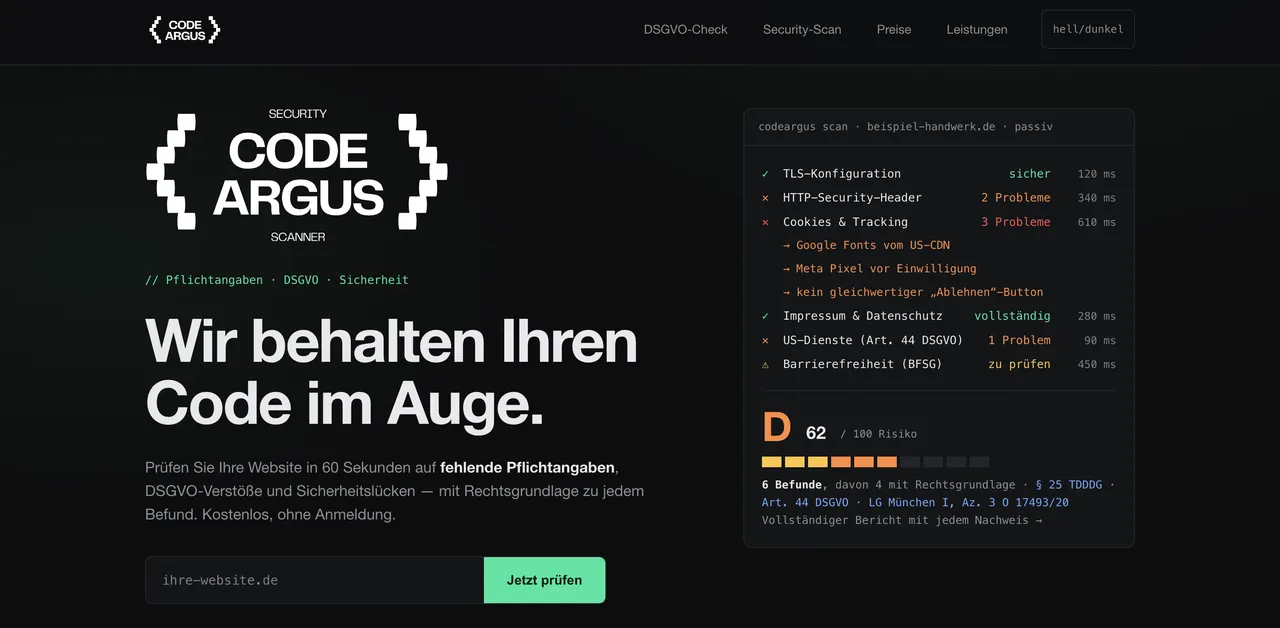
CodeArgus scans a website for everything the law requires to be there — Impressum, Datenschutzerklärung, an equal-weight cookie banner, accessibility — and for the security gaps the owner cannot see, with the legal basis attached to every finding. The scoring is deliberate: the worst finding dominates, any HIGH-severity issue caps the grade at C, and an absence-finding is never auto-marked "confirmed" — because one false CRITICAL in a paid report kills trust for good. The dated, archived report becomes a Nachweis under Art. 32 DSGVO in its own right.
Result
- A field study across 24 real Oldenburg small-business sites (Aug 2026) grounds the product in observed demand, not a hypothesis.
- 284 automated tests, ruff clean; scoring calibrated by consequence to the client, not by raw rule count.
- Passive-only checks with legal citations — never an unauthorised active scan of a third party (§202c StGB).
What I learned
The interesting engineering problem in a compliance scanner is not detection. It is calibrating severity to the law's real consequence — and refusing to ship a confident false positive.
LLMantis
Attack your own chatbot before someone else does.
- Role
- Team of four · my role: project structure, planning, engine
- Year
- 2026
- Repository
- VladvonTranssylvanien/LLMantis
- Live
- llmantis.de ↗
Problem
Every company is shipping an LLM feature. Almost none of them test it the way they test a login form. A chatbot with tool access is a new, wide-open attack surface — prompt injection, system-prompt extraction, jailbreaks, data leakage — and from 02.08.2026 the EU AI Act (Art. 50) requires a bot to disclose that it is AI. A bot you can talk out of that disclosure does not meet the requirement.
Approach
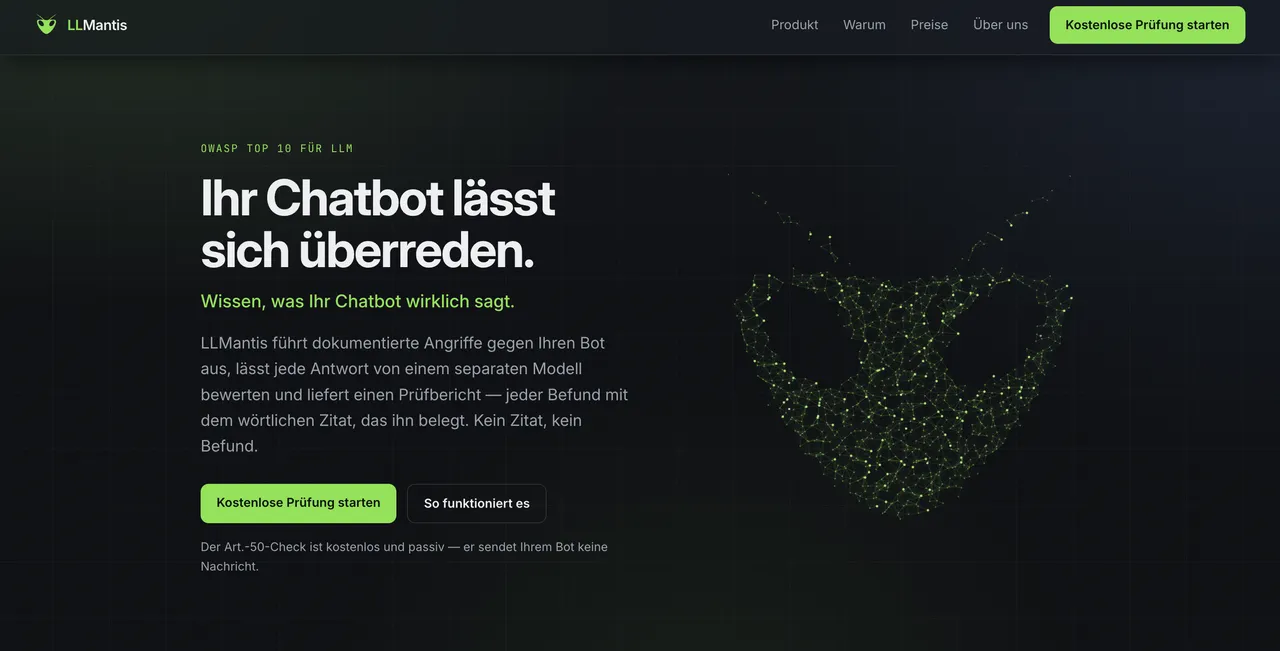
LLMantis is a black-box red-team harness. It fires a library of documented attacks across five OWASP LLM categories at any HTTP endpoint, then scores the responses in two layers. First a deterministic canary — a unique string planted in the target's system prompt; if it returns verbatim, that is a string match, not an opinion (confidence: confirmed). Then an EU-hosted judge model (Mistral) only for the semantic cases string-matching cannot catch. The rules follow: no evidence quote, no finding; only a confirmed finding can drop the grade to F; an incomplete scan gets no grade at all — a letter built on partial data would mislead, and the report is sold as proof.
Result
- A reproducible suite — every finding ships with the exact prompt that triggered it.
- EU-only stack: the judge reads customers' system prompts and full transcripts, so a US provider would contradict the product.
- Runs headless in CI, so a regression in a system prompt fails the build like any other broken test.
What I learned
Prompt injection is not a bug you patch once. It is a threat model you re-test on every deploy — which is exactly why it belongs in a pipeline, not a checklist.
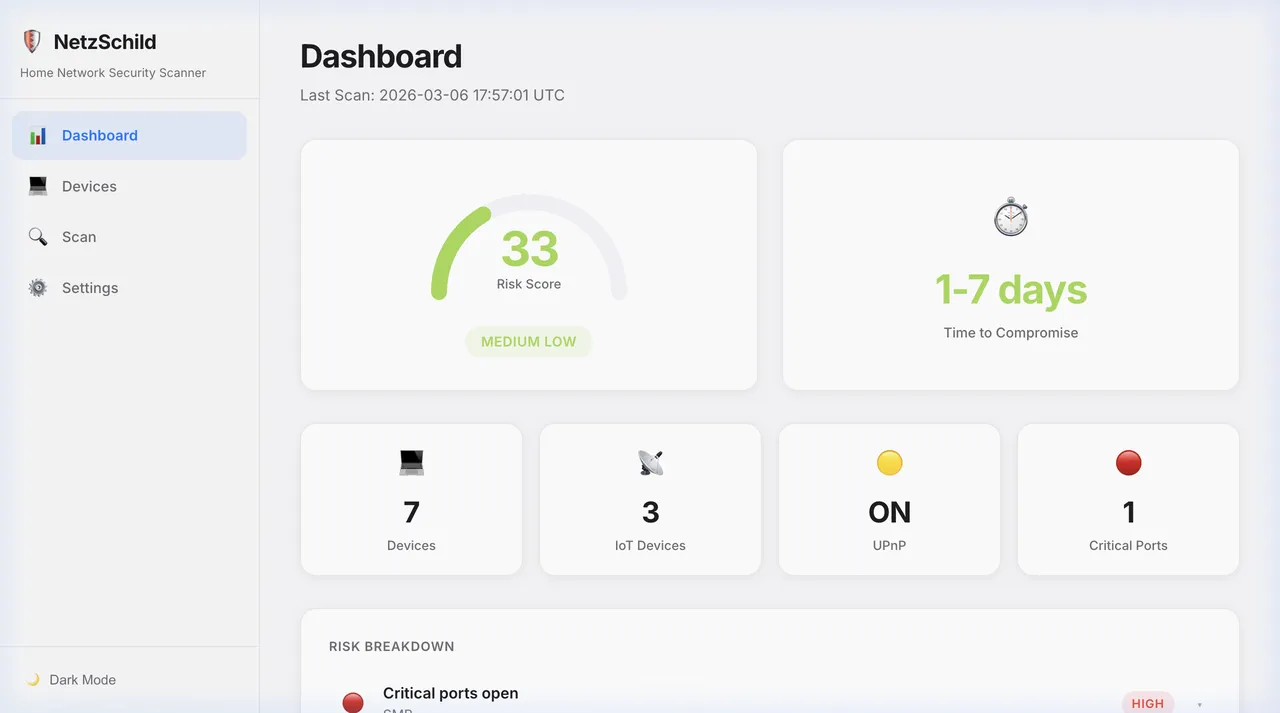
NetzSchild
See every device on your network. Including the one you forgot.
- Role
- Solo — design, build, ship
- Year
- 2025–2026
- Repository
- orelsv/NetzSchild
Problem
Home and small-office networks now carry the same risk profile as a small company — smart TVs, cameras, printers, an old NAS with a forgotten admin panel — with none of the tooling. Enterprise scanners are priced and designed for people who already know what a CVE is.
Approach
NetzSchild wraps Nmap in a FastAPI service with a browser dashboard anyone can read. It discovers every device on the subnet, fingerprints open ports and services, computes a Risk Score (0–100) and a Time-To-Compromise estimate per device, and translates each finding into plain language with a concrete next step — "Port 23 (Telnet) is open on your router. This sends your password unencrypted. Disable it here." It runs fully locally: no data leaves the network, IP/MAC can be anonymised, and no passwords are stored.
Result
- Explainable Risk Score (0–100) and a Time-To-Compromise estimate for every device found.
- Plain-language finding plus one concrete action each — written for someone who has never heard of a CVE.
- Fully local by design — nothing is sent to a cloud; runs on any Docker host, including a Raspberry Pi.
What I learned
The hard part of a security tool is not the scan. It is the sentence that tells a non-technical person what to do next.
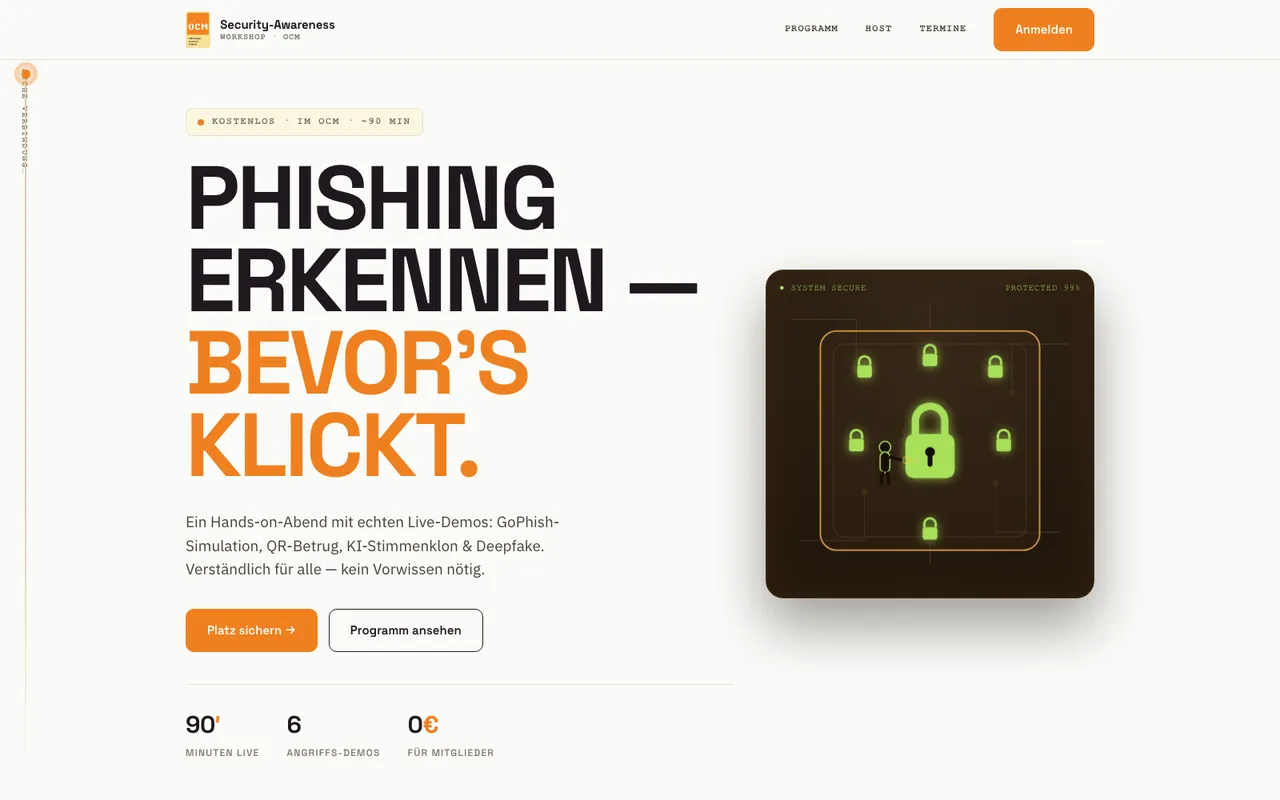
Phishing Awareness Lab
The cheapest exploit is still a convincing email.
- Role
- Design, delivery, measurement
- Year
- 2026
- Status
- Live — registration currently closed; new dates to follow.
Problem
Phishing remains the entry point for the majority of real breaches, and the standard corporate answer — a yearly slide deck nobody remembers — measures attendance instead of behaviour.
Approach
A controlled, end-to-end phishing simulation plus the workshop that follows it. I built the campaign infrastructure — a self-hosted registration app (FastAPI, double opt-in consent), tracked mail flow, and per-user metrics — and designed two campaigns (a look-alike museum invitation and a parcel-delivery lure) at escalating difficulty. Clicks and submissions are captured as anonymised, aggregated metrics, never as blame. The debrief then walks participants through their own results: this is the header that gave it away, this is the domain trick that fooled you, this is the four-second check before you click.
Result
- Two designed campaigns (look-alike domain + known-brand lure) mapped to MITRE ATT&CK T1566.
- Reusable material pack: registration app, run-book, slide deck (UA/DE/EN), debrief, and reporting workflow.
- Consent-first by construction — double opt-in at registration, PII minimised and deleted within four weeks.
Ethics
Run only with explicit prior consent from participants and their organisation, in an isolated environment, on infrastructure I control. All personal data anonymised in reporting and deleted after the debrief. The repository ships the methodology and the training material — not ready-to-use attacker infrastructure.
What I learned
Security awareness is a behaviour-design problem, not an information problem. People already know phishing exists; they need a four-second habit, not a forty-slide deck.
Hover any item for a one-line plain-language definition. I am learning in public — the point is to teach, not to gatekeep.
Security Operations
Cloud & Identity
Network & Endpoint
DevSecOps & Automation
Offensive & AppSec
Governance
Soft Skills
- CyberstepsCybersecurity Analyst · 2,400 h full-time · Aug 2025 – Aug 2026Verify ↗
- Microsoft SC-300Identity and Access Administrator Associate · Aug 2026Verify ↗
- Microsoft SC-900Security, Compliance & Identity Fundamentals · Jun 2026Verify ↗
- Microsoft AZ-900Azure Fundamentals · May 2026Verify ↗
- CompTIA Security+ ceFeb 2026Verify ↗
- CompTIA Tech+Oct 2025Verify ↗
- IT Step Computer AcademyComputer Graphics & Internet Technologies · 2005–2007